Stale records dominate the queue
Old dumps, duplicated collections, and repackaged breach data can make every alert look urgent even when the underlying exposure has been known for years.
Keep relevant exposure in view
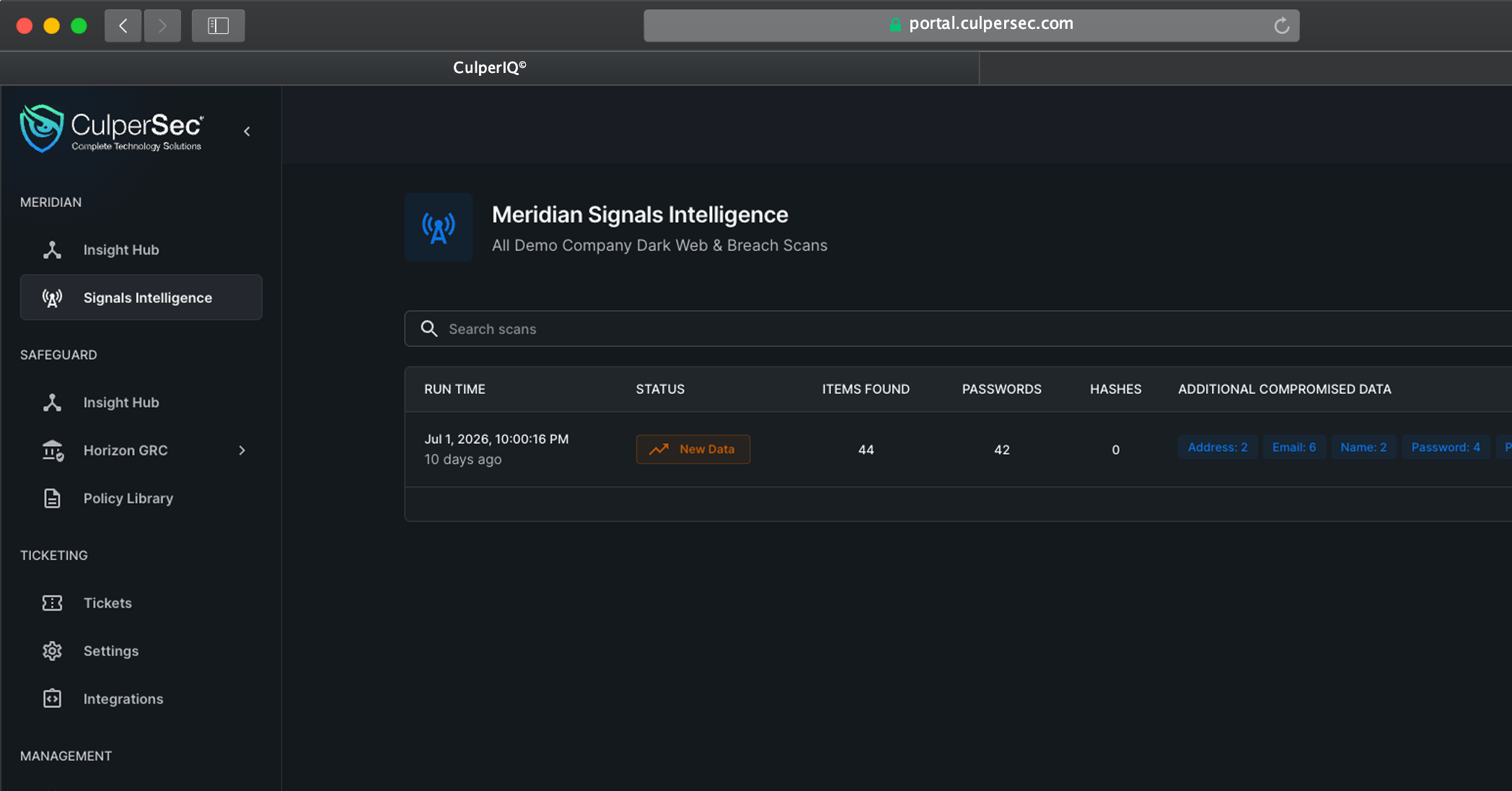
Signals Intelligence centralizes historical and newly observed exposure, then helps teams focus the queue around current users and records that can still lead to account abuse.
Old dumps, duplicated collections, and repackaged breach data can make every alert look urgent even when the underlying exposure has been known for years.
A breach record alone does not show whether the person is still employed, the mailbox still exists, or the exposed account can still affect the organization.
Generic exposure notifications create backlog when they do not give security teams enough context to prioritize password resets, account review, or investigation.
Replace a passive feed of credential records with an organized view of domains, users, history, and newly observed findings that security teams can actually triage.
Bring historical and newly observed breach records into one searchable workspace instead of reviewing isolated feeds and one-off notifications.
Create one exposure history
Track company domains across breach and dark web sources to identify records tied to organizational identities and public-facing exposure.
Keep company exposure in scope
Review exposure in the context of the affected identity so analysts can understand repeated records and prioritize users who still have active access.
Make identity the unit of response
Remove departed users from future results so recycled breach data does not repeatedly push irrelevant identities back into the active queue.
Reduce persistent noise
Use monthly automated scans and on-demand scanning to refresh exposure data when teams need an immediate view of current findings.
Keep the dataset current
Notify teams when monitored domains or users appear in new breach data so relevant changes do not disappear inside the historical record.
Focus on material change
Give IT and security teams the identity and breach context needed to review accounts, rotate credentials, validate MFA, or investigate broader compromise.
Turn exposure into action
Use a repeatable monitoring and triage cycle to separate relevant organizational exposure from the stale and recycled data that erodes analyst trust.
Define the organization domains and current users that should remain under breach and dark web monitoring.
Search historical and newly available breach sources on a monthly schedule or run an on-demand scan when needed.
Group records around organizational identities and preserve the exposure history needed to understand repeated findings.
Remove former-employee noise and separate active identities and newly observed exposure from low-value historical clutter.
Use the available context to guide credential rotation, MFA review, account isolation, endpoint investigation, or other follow-up.
Signals Intelligence helps teams understand who is exposed, whether the identity still matters, and which records deserve account review or broader investigation.
Signals Intelligence is one part of Meridian. Explore the other assessment, email assurance, vulnerability, cloud posture, AI monitoring, and security operations products available in CulperIQ.
Manage penetration test and security assessment findings, ownership, remediation progress, and reporting in one workspace.
Continuously validate email authentication, DNS security, blacklist status, DMARC reporting, and configuration drift across company domains.
Identify, prioritize, investigate, and track vulnerabilities across managed endpoints and infrastructure.
Centralize endpoint security events and operational context for investigation, monitoring, and response inside Meridian.
Test and monitor cloud environments for security gaps, misconfigurations and posture drift.
Unify endpoint harness activity with Microsoft Copilot usage, inventory, and risk plus Claude Enterprise analytics, platform, code, and governance.
See how Signals Intelligence centralizes breach history, monitors current users, reduces former-employee noise, and gives response teams clearer context.