Secure records still drift
Provider changes, migrations, inherited DNS, and routine administration can weaken email authentication long after the original configuration was approved.
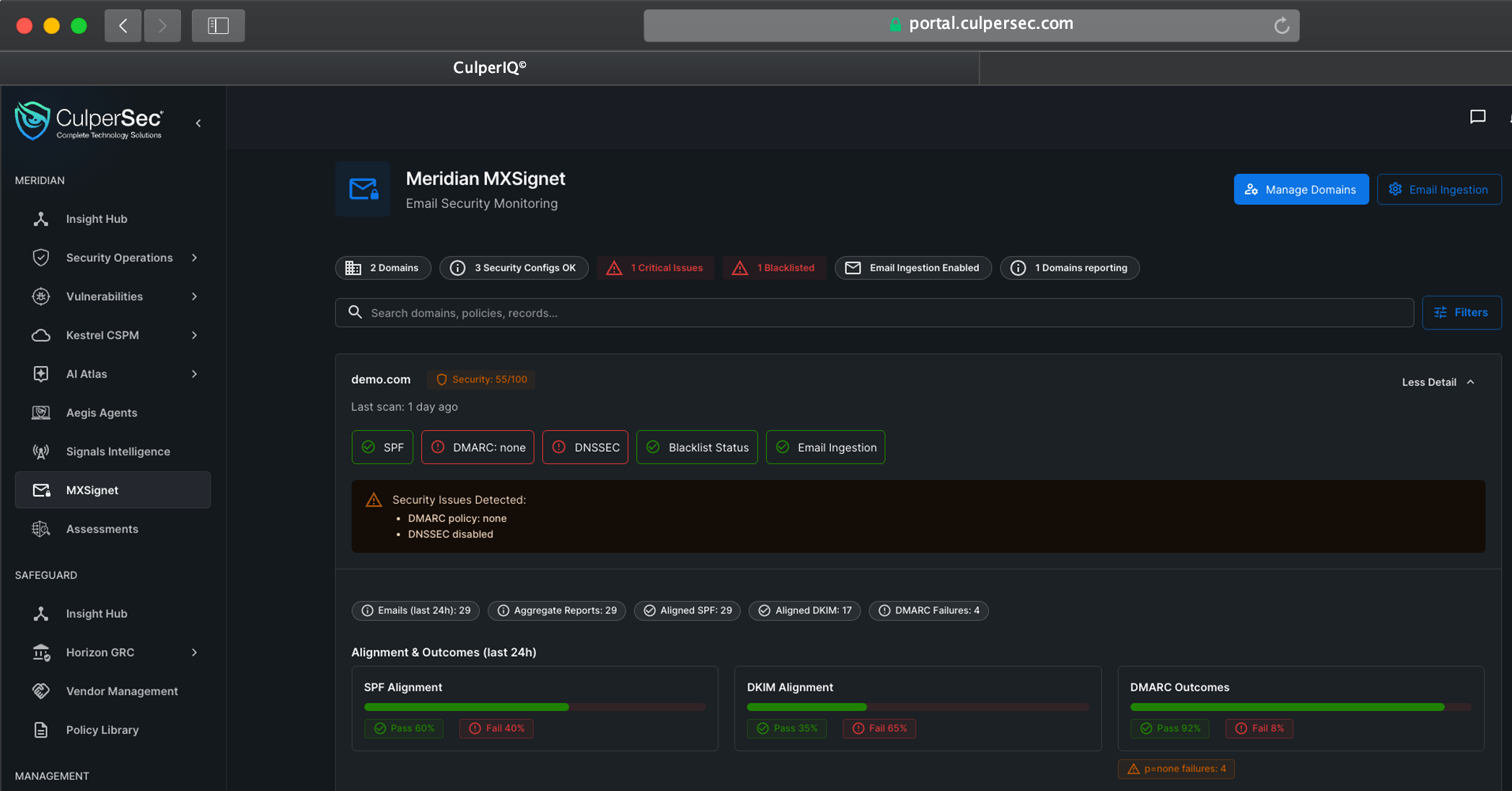
Continuously validate critical controls
MXSignet receives DMARC aggregate and forensic reports while continuously checking the public controls and reputation signals that determine whether your domains can be trusted.
Provider changes, migrations, inherited DNS, and routine administration can weaken email authentication long after the original configuration was approved.
A clean assessment only describes one moment. It does not show when a DMARC policy changes, DNSSEC breaks, or a domain appears on a blacklist later.
Primary, secondary, and newly introduced domains can carry email risk even when security teams are only watching the organization's best-known domain.
MXSignet combines DMARC report receipt, domain discovery, deep record validation, blacklist monitoring, and change history so teams can distinguish real drift from unchanged configuration.
Inventory primary and secondary domains from company profiles so teams can expand monitoring without collecting credentials or maintaining a manual list.
Start with broader coverage
Continuously check MX and DNS security posture, including SPF, DMARC policy, DKIM alignment inference, and DNSSEC configuration.
Know which controls hold
Use the reporting address provided during MXSignet setup as the DMARC RUA and RUF destination so aggregate and forensic reports are received in one place.
Centralize DMARC reporting
Track email infrastructure against more than 100 industry-standard and premium blacklist providers to surface reputation and compromise concerns.
See reputation risk early
Record the accepted configuration on first review and preserve historical snapshots so teams can distinguish known posture from unexpected change.
Define the trusted state
Compare new scan results against the baseline and highlight changes such as DMARC policy shifts instead of repeatedly alerting on unchanged records.
Reduce alert fatigue
Give IT and security teams the affected domain, record state, change history, and validation result needed to investigate and restore secure posture.
Move from signal to action
Replace occasional manual checks with a repeatable monitoring cycle that preserves the expected state and makes material changes easier to investigate.
Identify the primary and secondary domains that make up the organization's public email footprint.
Route DMARC reports to the MXSignet-provided address, then check authentication, DNS security, mail routing, and blacklist status.
Establish the accepted record state and retain structured snapshots for future comparison and compliance history.
Repeat validation continuously and separate material configuration changes from records that remain unchanged.
Review drift or reputation findings with the domain context and history needed to assign and verify remediation.
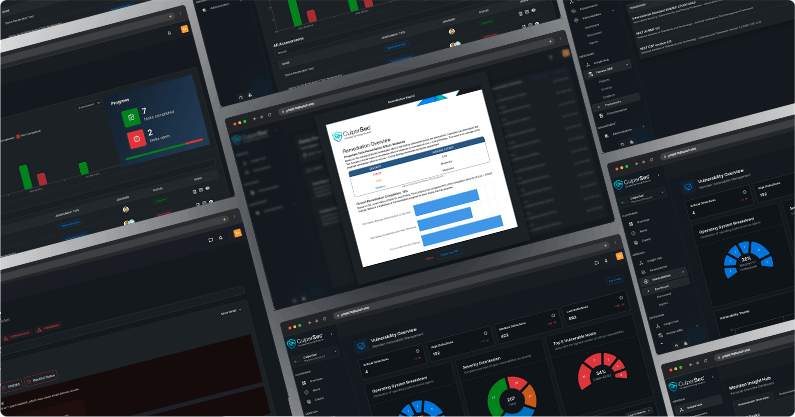
MXSignet gives IT and security teams a current, defensible view of email authentication, DNS posture, reputation, and configuration history across the organization's domain footprint.
MXSignet is one part of Meridian. Explore the other assessment, exposure, vulnerability, cloud posture, AI monitoring, and security operations products available in CulperIQ.
Manage penetration test and security assessment findings, ownership, remediation progress, and reporting in one workspace.
Monitor breach and dark-web exposure for company domains and active users, with context that helps teams focus response.
Identify, prioritize, investigate, and track vulnerabilities across managed endpoints and infrastructure.
Centralize endpoint security events and operational context for investigation, monitoring, and response inside Meridian.
Test and monitor cloud environments for security gaps, misconfigurations and posture drift.
Unify endpoint harness activity with Microsoft Copilot usage, inventory, and risk plus Claude Enterprise analytics, platform, code, and governance.
See how MXSignet receives DMARC reports and monitors authentication controls, DNS security, blacklist status, and configuration drift.